Understand Your Rights. Solve Your Legal Problems
Public appearances involving Norway’s royal household are being reviewed following the arrest of Marius Borg Høiby just days before his scheduled criminal trial, according to people familiar with planning around upcoming events. No formal cancellations have been announced.
Oslo police confirmed on Sunday that Høiby was arrested ahead of his trial on multiple criminal charges, including rape, assault, and drug offences. Prosecutors said the latest arrest relates to new allegations of assault, threats involving a knife, and breach of a restraining order.
Høiby had previously been indicted and was not in custody while awaiting trial. The new arrest comes shortly before proceedings are due to begin, altering the legal context in which the case will now be heard.
Police and prosecutors have not said whether the latest charges will be handled separately or addressed alongside the existing indictment. Legal proceedings in Norway allow for adjustments to case scope and scheduling when new allegations arise close to trial.
No court findings have been made, and Høiby has denied the most serious charges. Under Norwegian law, defendants are presumed innocent until proven guilty.
The case has drawn sustained public attention due to Høiby’s family ties to Norway’s royal household, which remains a prominent public institution with a regular calendar of official and ceremonial appearances.
While no public statements have been issued regarding changes to royal engagements, individuals involved in event planning say schedules are being reviewed as the legal process continues.
Criminal trials proceed according to court timetables, and the introduction of new allegations near a trial date can extend procedural timelines. Prosecutors have not indicated whether the arrest will affect the start date of proceedings.
For now, the case remains ongoing. Any decisions regarding trial scope, timing, or additional charges will be made by the court.
The U.S. Department of Education has proposed rules to cap graduate student borrowing and simplify federal loan repayment, affecting colleges, graduate students, and loan servicers in 2026.
The U.S. Department of Education has issued a Notice of Proposed Rulemaking to implement recent changes to federal student loans.
The proposal follows statutory amendments tied to the Working Families Tax Cuts Act.
It would cap graduate and professional borrowing, eliminate Grad PLUS loans, and reduce repayment plan options.The rule matters now because it sets borrowing limits for students entering programs in mid-2026 and reshapes repayment administration across the federal system.
The proposed rule would eliminate the Grad PLUS program, which has allowed graduate and professional students to borrow up to the full cost of attendance set by their institution.
In its place, the Department would apply statutory annual and lifetime borrowing caps that materially reduce how much students can access through federal loans.
From July 2026, new graduate students would be limited to $20,500 per year, with a total borrowing cap of $100,000.
New professional students would face higher limits — $50,000 annually and $200,000 over a lifetime — but still well below the open-ended borrowing previously available under Grad PLUS.
The rule would also permit colleges to impose program-level loan caps below the federal maximums, giving institutions discretion to restrict borrowing further.
Compliance would be enforced through existing Title IV oversight mechanisms, including routine audits and program reviews.
Federal data have shown that graduate student borrowing has increased faster than undergraduate borrowing for more than a decade.
The availability of unlimited Grad PLUS loans has been linked to higher tuition pricing in certain graduate and professional programs.
Lawmakers have also pointed to rising default exposure and growing balances in income-driven repayment plans as evidence of long-term risk to both borrowers and taxpayers.
The rule operates within Title IV of the Higher Education Act, which governs federal student lending.
Congress sets borrowing authority through statute, while the U.S. Department of Education implements those limits through negotiated rulemaking and regulation.
Once finalized, the rule would carry the same legal force as existing Title IV regulations, requiring institutional compliance to maintain federal aid eligibility.
Courts reviewing challenges typically examine statutory authority, procedural compliance, and whether the regulation is reasonable under established administrative law standards.
Colleges and universities would be required to restructure graduate financial aid packaging to comply with new statutory borrowing caps, which may force changes to tuition pricing, institutional aid, or internal financing models.
Loan servicers would also need to update repayment systems as legacy plans are phased out, alongside revised borrower disclosures, staff training, and default rehabilitation procedures to meet Title IV compliance requirements.
For students, the rule would introduce defined federal borrowing limits before enrollment and reduce repayment options to a tiered standard plan or a single income-driven plan, simplifying choice while limiting flexibility.
Borrowers in default would gain a second statutory opportunity for loan rehabilitation, allowing loans to return to good standing and removing default-related penalties upon successful completion.
The most immediate change is how borrowing limits are set. Graduate and professional students would no longer be able to borrow based on tuition or cost of attendance.
Instead, borrowing would be capped by statute, meaning many students may need to seek private financing or institutional aid to cover remaining costs.
The rule would apply to any institution participating in federal Title IV aid programs. Compliance is not optional. Schools that fail to adhere to the new limits would risk enforcement action through program reviews and, in serious cases, loss of federal funding eligibility.
The caps would apply only to new borrowers beginning in July 2026. Existing federal loans would remain governed by prior rules, and current balances would not be retroactively adjusted.
Institutions would also be permitted to impose stricter program-level borrowing caps below the federal maximums.
This discretion could be exercised using earnings data, default rates, or internal risk assessments, shifting more responsibility to colleges to police borrowing outcomes.
The proposed rule is open for public comment for 30 days, after which the Department will review submissions through the federal rulemaking process before publishing a final version in the Federal Register.
If adopted in its current form, implementation would begin in July 2026, aligned with statutory timelines and the academic calendar, giving institutions limited time to revise financial aid policies, disclosures, and compliance systems.
Substantively, the proposal represents a shift in how federal graduate lending operates. Open-ended borrowing tied to institutional pricing would be replaced with fixed statutory limits, reducing federal exposure while transferring planning risk to students and schools.
Even before finalisation, the regulatory direction is clear, and institutions and borrowers would need to account for tighter controls and reduced flexibility well ahead of the 2026 start date.
In early 2026, SiriusXM agreed to pay $28 million to settle a class action lawsuit over alleged do-not-call violations, ending a case that had been running since 2022.
The lawsuit claimed that people were contacted even after registering with the National Do Not Call Registry or directly asking the company to stop calling.
SiriusXM denied wrongdoing as part of the agreement, a standard position in settlements of this type.
The payment reflects a negotiated resolution rather than a judicial finding, but it nevertheless closes off a growing area of legal exposure tied to automated outreach, consent management, and telemarketing compliance.
The lawsuit alleged that calls were made between April 27, 2019, and October 31, 2025, after recipients had either registered their numbers with the federal do-not-call database or requested placement on SiriusXM’s internal suppression list.
While individual calls may appear minor in isolation, the uniformity of the alleged conduct created the conditions for class treatment.
From a legal risk perspective, that aggregation is decisive. Systems designed to scale outreach efficiently can also scale non-compliance when controls fail, turning repeated low-level interactions into a material regulatory and litigation issue.
The settlement creates a defined claims class rather than universal entitlement. To qualify, individuals must show that they were contacted more than once by SiriusXM during the relevant period and that one of the following conditions applied at the time of the calls:
They were not SiriusXM subscribers and had been listed on the National Do Not Call Registry for at least 31 days, or they had asked to be placed on SiriusXM’s internal do-not-call list and still received a subsequent call.
The structure reflects a common feature of consumer class actions: eligibility is tied not to general dissatisfaction, but to specific regulatory triggers that courts recognise as enforceable.
The deadline to file a claim is March 21, while objections to the settlement must be submitted by March 27.
A final approval hearing is scheduled for May 11, at which point the court will decide whether the agreement should receive final sign-off.
Claims must be submitted through the official SiriusXM settlement website, rather than directly through the court.
As with most settlements of this kind, compensation will depend on the number of valid claims received and the court’s final approval of the distribution process.
The $28 million settlement reflects a costed decision to cap legal and regulatory exposure rather than a punitive finding. Continuing the litigation would have required sustained legal spend, compliance resources, and management attention, while leaving the underlying risk unresolved.
For subscription and telemarketing businesses, the case reinforces a core compliance principle. Consent management, suppression lists, and opt-out mechanisms function as legal controls, not operational conveniences.
Failures at scale are likely to attract class action risk rather than isolated regulatory intervention.
For consumers, the settlement provides a procedural remedy through a defined claims process, without any judicial determination on liability.
More broadly, the case illustrates how repetitive process failures convert low-level consumer friction into actionable legal exposure, with aggregation, rather than individual harm, driving liability.
Schools, youth organisations, and parents are already changing how they use social platforms not because a court has ruled, but because uncertainty has arrived.
Some programmes are delaying new digital rollouts, while others are pulling back from platforms they once relied on for communication and outreach. The hesitation isn’t driven by a verdict. It’s driven by exposure.
The shift comes as Meta Platforms prepares to face a jury in New Mexico next week over allegations that its platforms exposed children and teenagers to sexual exploitation.
The case has not been decided, but the pressure it creates is already shaping behaviour well beyond the courtroom.
For organisations that work with minors, the calculation has quietly changed. Using large social platforms now feels less like a default and more like a risk decision that has to be justified.
Even without a ruling, the possibility of future liability, scrutiny, or reputational fallout is enough to slow action.
The lawsuit was brought by the state of New Mexico, accusing Meta of allowing harmful activity involving children and profiting from it. It is the first case of its kind against a major social media company to reach a jury.
The scope is significant, but the outcome remains unknown.
What matters now is not what the jury will decide, but what the existence of the trial signals. Once a case reaches this stage, it becomes harder for institutions to assume that existing safeguards will be viewed as sufficient.
The uncertainty sits squarely with anyone relying on these platforms to interact with young users.
Because the trial has not yet begun, there is no guidance, no precedent, and no clear boundary for what counts as acceptable practice. That lack of clarity is what creates pressure.
Trials of this scale do not resolve quickly, and appeals or parallel actions could follow regardless of the outcome. That timeline matters.
When uncertainty stretches forward with no clear endpoint, delay becomes a rational response.
Schools considering new digital engagement tools are holding back. Youth charities are reviewing existing accounts instead of expanding them.
Some parents are opting out of platform-based communication entirely, choosing slower or less convenient alternatives.
None of these moves require a finding of wrongdoing. They happen because the risk profile has changed.
Exposure now feels open-ended, and institutions that cannot absorb reputational or legal shock are acting accordingly.
There has been no official directive telling organisations to stop using Meta’s platforms. No regulator has issued a blanket warning. Yet behaviour is changing anyway.
Digital safety reviews are being moved forward. Platform choices are being questioned where they were once assumed. In some cases, organisations are fragmenting their online presence, spreading activity across multiple channels to avoid dependence on a single provider.
These shifts are observable, practical, and driven by uncertainty rather than compliance. The legal process itself — slow, public, unresolved — is enough to create friction.
The trial raises a question that has no immediate answer: if a platform can be taken to trial over how it handles child safety, where does responsibility land for the organisations that use it?
That question isn’t being resolved in court next week. But it’s already influencing decisions. Until there is clarity, many actors are choosing caution, even if it means losing reach, efficiency, or connection.
For parents, the uncertainty feeds into trust. For schools and charities, it feeds into governance. For platforms, it feeds into scrutiny that extends beyond the specific allegations.
If the pressure continues, hesitation may become the new normal. Platform use involving minors could remain constrained, fragmented, or provisional, with decisions revisited repeatedly as the legal process unfolds.
If the pressure eases, usage may resume but with heavier oversight and less assumption of safety by default. Either way, the disruption does not wait for a verdict.
What’s unfolding now is not a legal outcome, but a behavioural shift. The law hasn’t spoken yet. But its shadow already has.
For many shoppers, the disruption didn’t arrive with a warning at checkout or a notice on the shelf. It arrived after the groceries were already home.
A federal recall tied to unsanitary conditions at a distribution facility has quietly pulled thousands of everyday products into uncertainty, forcing consumers to make decisions before any illness, investigation, or courtroom finding ever appears.
The trigger is a recall involving products distributed by Gold Star Distribution, Inc., after the U.S. Food and Drug Administration determined that the company’s Minneapolis facility was operating under insanitary conditions.
According to the agency, inspectors found evidence of rodent and bird waste, raising the possibility that products may have been exposed through contaminated surfaces or airborne particles.
That determination alone was enough to shift control immediately, without waiting for proof of harm in individual cases.
What makes the recall feel jarring is how familiar the affected items are. Snacks like Pringles, spreads such as Nutella, and breakfast staples including Cheerios appear on the list alongside drinks, pet food, cosmetics, and over-the-counter products.
The company’s guidance is direct: consumers should destroy the affected items. But for households, that instruction collides with everyday reality—sealed packaging, recent purchases, and the assumption that trusted brands are safe by default.
The pressure point here isn’t a lawsuit or a trial. It’s a regulatory classification. The FDA assigned the recall a Class II designation, meaning use of the products could cause temporary or medically reversible health effects, while serious consequences are considered unlikely.
Still, the designation doesn’t slow daily life. It accelerates it. Shoppers are left to decide what to throw away, what to replace, and what similar items might now feel questionable—all before any adjudication or follow-up finding.
What’s at stake right now is less about confirmed illness and more about trust in systems consumers rarely see. The issue isn’t how these products were manufactured, but what happened once they entered the distribution chain.
That procedural distinction matters because it widens the impact. Even sealed goods can be recalled if they’re believed to have passed through a compromised environment, turning back-end logistics into front-line consequences for ordinary households.
In practical terms, the effects are small but cumulative. People hesitate at checkout, scanning labels they once ignored. Parents rethink packed lunches. Pet owners debate whether unopened food is worth the risk.
There’s also the quiet cost—time spent checking UPC codes, replacing items that weren’t budgeted for, and absorbing the waste of throwing out products that may never have caused harm but now carry uncertainty.
This pattern isn’t unusual. Distribution-level recalls surface every year, often long after products have already dispersed widely. Because they rely on process rather than proof of injury, they tend to arrive fully formed.
By the time most consumers hear about them, the system has already decided that caution outweighs convenience, and the burden of that decision lands at kitchen counters and pantry shelves.
That creates a familiar tension. Consumers expect protection, but also consistency. Pulling thousands of products at once can feel excessive to some and overdue to others.
The debate lives in the space between trust and transparency—whether early intervention strengthens confidence in the food system or quietly erodes it by reminding people how little visibility they have into what happens after products leave the factory.
For now, there are no confirmed reports of widespread illness tied to these recalled items and no courtroom weighing of responsibility. What exists instead is a pause in certainty.
Items that were routine yesterday now require second thoughts, and the resolution doesn’t come with a verdict. It comes slowly, through replacement, silence, and the moment when shoppers stop checking labels and start trusting the shelf again—whenever that turns out to be.
The legal trigger arrived quietly and early in the day: a brief hearing at Southwark Crown Court tied to allegations that stretch back nearly two years.
Brown attended the hearing alongside a co-defendant, US rapper Omololu Akinlolu, also known as HoodyBaby, who is named in relation to the same alleged incident.
For Chris Brown, the moment mattered not because a verdict was near, but because procedure had switched on a different kind of pressure. Bail terms, travel conditions, and a return date suddenly shaped his weeks.
The outcome is distant, but the constraints are immediate.
Inside the courtroom, Brown said little beyond confirming his name. Outside, the contrast was jarring—fans waiting, photos held out, autographs signed.
It looked like a normal celebrity moment, except it happened between court steps and security checks. The legal system had already entered his schedule, rearranging it in plain sight.
The case centers on allegations tied to an early-morning incident at a London nightclub, with Brown pleading not guilty to all charges.
Another hearing date has been set months away, and the trial itself is not expected until later in the year.
That gap matters. Time, not testimony, becomes the dominant force, stretching uncertainty across tours, appearances, and everyday decisions.
This is the legal fault line most people never see. Before any facts are tested, the system asserts control through conditions—where someone can go, who they can speak to, how they move across borders.
Brown’s situation illustrates how procedure can stall momentum long before a jury ever hears a word. The law here functions less like a judgment and more like a lever.
The practical effects are specific and unglamorous. Travel requires notification and coordination; addresses must be logged; certain venues are off-limits.

US rapper Omololu Akinlolu, also known as HoodyBaby, is a co-defendant in the case and attended the London court hearing alongside Chris Brown.
Past permission to tour came with passport restrictions that turned every border crossing into a check-in. These details don’t decide guilt or innocence, but they do decide rhythm—what’s possible this month versus next.
There’s also the reputational math that plays out in real time. Silence is often the safest response, yet it leaves a vacuum filled by images: a courtroom arrival, a brief wave, autographs on the pavement.
Each snapshot carries weight without resolving anything. Public attention moves faster than the court calendar, and that mismatch creates its own strain.
This pattern isn’t unusual for public figures. Athletes miss seasons while investigations inch forward. Actors pause projects as insurers wait. Musicians reschedule tours around hearings that last minutes.
Procedure quietly shapes outcomes not by deciding cases, but by deciding timing—and timing decides leverage.
That tension opens a safe controversy readers recognize. Is the law protecting everyone involved by slowing things down, or does delay itself become a penalty?
How much exposure is unavoidable once a case becomes public, even when nothing has been proven? The answers depend on where you stand, which is why these moments spark debate without delivering closure.
For Brown, the human position at the center of this is narrow and uncomfortable. A future date looms, conditions remain in force, and daily life continues under watch. The court has not weighed evidence, and no finding is imminent.
Yet the pressure is already doing its work—reshaping calendars, narrowing options, and turning waiting into the main event.
Nothing here is finished. The allegations remain contested, the process unresolved. What exists now is the in-between space the law creates so effectively, where consequences arrive early and certainty comes later—if it comes at all.
For years, the legal reckoning surrounding Matt Lauer appeared to have stalled. No criminal charges followed his 2017 firing from NBC. No courtroom proceeding ever weighed the allegations against him.
But the release of a new memoir by his former colleague Brooke Nevils has quietly shifted the balance again, reintroducing pressure that takes effect long before any judge or jury becomes involved.
The trigger is not a new lawsuit or an indictment. It is narrative revival. Nevils’ forthcoming book revisits her allegation that Lauer assaulted her during the 2014 Winter Olympics, an accusation he has consistently denied.

Brooke Nevils is seen outdoors in New York amid reporting on her memoir and its renewed legal and reputational impact.
What matters now is not the truth of the claim, but the procedural reality that renewed allegations can reshape exposure years later, even when formal legal action is absent.
This is where modern legal pressure lives, not in verdicts, but in timing.
In situations like this, the legal fault line is defined less by guilt or innocence and more by consequence. Criminal statutes may have expired. Civil claims may be difficult or impossible to pursue.
Yet none of that prevents reputational harm, financial risk, or professional isolation from resurfacing when allegations re-enter public circulation. The law may be dormant, but its shadow is not.
For Lauer, the consequences arrive in the present tense. Attempts at professional rehabilitation remain constrained. Media institutions and business partners are forced to reassess proximity.
Silence becomes a choice with reputational cost, while response carries its own risks. The absence of a courtroom does not insulate against impact — it simply shifts where that impact lands.
Nevils’ account also highlights how timing redistributes power. When allegations surface alongside broader cultural shifts, procedural context can outweigh factual resolution.
Internal investigations, employment decisions, and negotiated exits often carry consequences that are more immediate than litigation itself. In these moments, the law operates as leverage rather than judgment.
This pattern is not unique. Across entertainment, media, and sports, public figures have seen careers stall or collapse without a single day in court. In many cases, the decisive moment is not a trial date but a publication date.
Once allegations are reintroduced through books or renewed reporting, the pressure resets, regardless of how much time has passed.
The personal consequences are asymmetric. For the accused, exposure brings renewed uncertainty, reputational damage without a clear mechanism for rebuttal, financial implications tied to stalled opportunities, and ongoing privacy erosion.
For accusers, going public again can reopen scrutiny and personal strain, even when legal pathways are no longer active.
What remains unresolved is not a legal question but a structural one. How long can allegations exert force in the absence of formal adjudication? And how does someone navigate a landscape where the most consequential moments arrive outside the courtroom?
For now, there is no ruling, no timeline, and no finality. Only renewed attention, constrained options, and the quiet reality that in public life, legal consequences often begin long before and sometimes without a trial.
For most people, a home sale is a financial decision. For Miles Guo, it has become something else entirely - a visible signal of how legal pressure can start closing doors long before a final sentence is ever handed down.
Guo, currently jailed in Brooklyn while awaiting sentencing in a federal fraud case, has slashed the asking price of his sprawling New Jersey mansion by $14 million in just over a year.
The property, once listed at $33 million, is now on the market for $19 million. The cut is steep, but the timing matters more than the number. This isn’t a luxury downgrade, it’s a consequence unfolding in real time.
At this stage, nothing new has been decided in court. There is no sentencing date on the calendar and no final accounting of what assets may ultimately be forfeited. Yet the financial pressure is already forcing movement.
Control over pace, leverage, and outcome has shifted, and the effects are landing now, not later.
The legal fault line here isn’t about guilt or innocence that question has already moved past the verdict stage. What’s at stake is timing.
When bankruptcy proceedings, asset seizures, and post-conviction processes overlap, choices narrow quickly.
Properties tied up in those processes can’t wait for closure. They sit, they bleed value, or they move at a discount.

Miles Guo is photographed inside a private office holding a Superman figurine during an earlier period of his business career.
That’s how a $26 million mansion, reportedly renovated with tens of millions more, ends up chasing buyers instead of commanding them. The sale isn’t just about recouping funds.
It’s about liquidity, compliance, and keeping ahead of legal mechanisms that don’t pause for personal preference.
The personal consequences are harder to quantify but easier to recognize. A home once designed for privacy, status, and permanence is now part of a public unwind. Listing photos circulate.
Price cuts get knowing headlines. Silence becomes conspicuous. Even without new filings, reputation continues to shift as assets tell their own story.
This kind of pressure isn’t rare among high-profile figures caught in prolonged legal aftershocks. Long before a judge sets final terms, lives begin reorganizing around uncertainty. Careers stall. Holdings shrink. Advisors move from growth to damage control.
The law doesn’t need to announce itself loudly — procedure does the work quietly.
For observers, the unsettling question is how early this starts. At what point does a case stop being about facts and start being about endurance?
When do legal timelines become life timelines, dictating when to sell, when to stay quiet, and when to let go?
That tension between money and time, control and compliance is where debate naturally forms. Is this the law doing its job by protecting creditors and victims?
Or is it a system that exerts punishment through delay and exposure before final outcomes are even clear?
For now, Guo remains in custody, waiting for the next procedural step. His mansion remains on the market, waiting for a buyer willing to step into the uncertainty. Nothing is finished. Nothing is settled.
But the pressure is already doing what pressure does best - reshaping everything around it, a pattern that mirrors how legal pressure reshapes lives before court outcomes.
A newly filed civil lawsuit against Sean ‘Diddy’ Combs introduces a form of legal pressure that doesn’t wait for a jury, a verdict, or even a hearing.
The complaint alleges that an accuser stayed silent for years after being threatened, with the threat tied to Combs’ purported power and reach.
No court has tested the claim, and no facts have been adjudicated. But the filing alone shifts control immediately, forcing consequences that arrive long before any trial.
According to the lawsuit, the plaintiff says he was assaulted in a New York hotel suite in 2012 and warned not to speak afterward.
The complaint claims the warning referenced violence and consequence, invoking the killing of rapper Tupac Shakur as a reminder of what could happen if he talked.
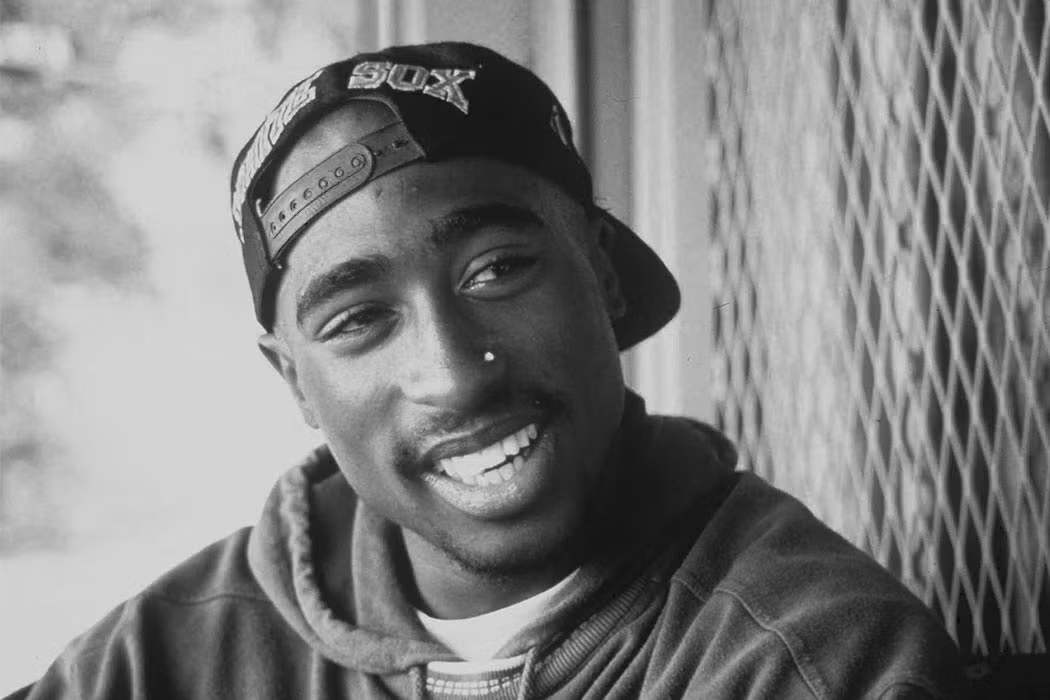
Rapper Tupac Shakur, whose 1996 killing is referenced in a newly filed lawsuit alleging threats made to silence an accuser.
Years later, the suit alleges, the threat was reinforced indirectly through others. The legal trigger is not what a judge decides later, but what the allegation explains now: delay.
That explanation is the fault line of the case. When a lawsuit claims silence was the product of fear rather than choice, the timeline itself becomes contested territory.
Courts may be asked to decide whether alleged intimidation justifies why a claim is arriving now, which can affect whether the case even proceeds. Those arguments happen early, often before discovery on the underlying facts begins.
This is where procedure matters more than proof, at least at this stage. Allegations of threats can complicate motions to dismiss, widen the scope of early discovery, and force arguments over communications that might otherwise remain irrelevant.
None of that requires a ruling on guilt or innocence. It simply means the case can become harder to contain, slower to resolve, and more public before anyone reaches the merits.
For a public figure, those mechanics translate quickly into real-world consequences. Decisions about whether to respond, stay silent, or fight publicly are no longer strategic abstractions; they affect reputation in real time.
Appearances, partnerships, and schedules can be impacted by the existence of the filing alone. Even without a court date, the pressure is active.
Financial exposure also enters earlier than many expect. Civil cases framed around alleged intimidation often bring settlement pressure long before evidence is tested, because uncertainty carries its own cost.
Legal teams must prepare for expanded document requests and prolonged motion practice while the narrative plays out in public.
Privacy narrows as past interactions and relationships become part of the procedural conversation, not because they have been proven, but because they have been alleged.
Situations like this follow a familiar pattern for high-profile defendants. Other public figures have faced cases where the earliest battles weren’t about what happened, but about why nothing was said sooner.
In those moments, procedure quietly decides leverage. The law doesn’t resolve the story; it stretches it.
That tension creates a broader question without forcing an answer. Does the legal system protect those who say fear delayed their claims, or does it risk turning unresolved accusations into years-long pressure campaigns?
Is publicity a tool of accountability, or does it become a form of punishment before judgment? The lawsuit raises those questions simply by existing.
The filing also arrives in the shadow of other litigation involving Combs. Since late 2023, he has faced a wave of civil claims following a lawsuit brought by his former partner Cassie Ventura, which settled quickly and preceded additional allegations.
Each new case adds procedural weight even before any court evaluates substance. The accumulation itself becomes part of the pressure landscape.
For now, nothing has been decided. There has been no ruling on credibility, no testing of evidence, and no judicial finding. What exists is a lawsuit that reframes years of silence as fear and delay as consequence.
The waiting begins not at trial, but here in the space where the law applies pressure without resolution.
When Lamar Odom checked into a 30-day rehab program days after being arrested on suspicion of driving under the influence in Las Vegas, the move landed far beyond the realm of personal recovery.
A criminal process had already been activated, and once that switch flips, timing becomes its own form of pressure.
For Odom, the immediate issue is not a verdict or even a courtroom appearance, but how early procedural steps can shape what happens long before a judge weighs in. His spokeswoman framed the decision as “taking responsibility,” but the legal clock does not pause simply because someone seeks treatment.
The arrest itself set the stakes. Police allege Odom was driving more than 100 mph and showed signs of impairment, claims he disputes while acknowledging past struggles.
That tension matters because a DUI charge carries consequences that begin immediately: license exposure, scheduling constraints, mandated evaluations, and reputational fallout that unfolds in real time.
Even without a conviction, the process can narrow options and force decisions quickly. Control shifts from the individual to the system, and the outcome becomes uncertain in ways that are hard to reverse.
The fault line here is procedural rather than moral. DUI cases often hinge on early steps—testing, documentation, compliance orders—that determine leverage before any facts are adjudicated.

Lamar Odom and Khloé Kardashian are pictured at a public event during their former relationship, a period that continues to shape public perception as Odom faces renewed legal and personal pressure.
Entering rehab can be seen as proactive, but it can also complicate scheduling, appearances, and negotiations if not carefully aligned with the case timeline.
Prosecutors, courts, and defense teams all operate on deadlines, and missing one can reshape a case overnight. Guilt or innocence is not being decided yet; momentum is.
That momentum has personal consequences that play out quietly. Odom’s work opportunities, travel plans, and public engagements now sit under a cloud of coordination and caution.
A suspended or restricted license can alter daily logistics. Silence versus response becomes a calculated choice, as every statement may echo later. Financial exposure also looms, from legal fees to potential fines, all accruing before any resolution is reached.
The strain is less about spectacle and more about endurance.
This pattern is not unique to Odom. Public figures often discover that procedure not headlines does the real shaping. Similar situations have unfolded where early compliance decisions, treatment enrollment, or missed dates narrowed outcomes long before trial.
The law operates like a lever at this stage: small movements can have outsized effects. It raises an uncomfortable question about access and resilience, whether navigating this phase is easier for those with resources, or simply more visible.
That question fuels a safe controversy without choosing sides. Is the law functioning as protection, encouraging accountability and recovery, or as an obstacle that compounds pressure regardless of intent?
Privacy erodes as routine steps become public knowledge. Power shifts to institutions that move on fixed schedules, indifferent to personal context. Money buys counsel and coordination, but it does not buy time.
For Odom, the human through-line remains unresolved. He has spoken about rebuilding his life after earlier crises, including health emergencies and financial disputes, and about wanting to move forward with integrity.
Rehab may help with recovery, but the case proceeds on its own track.
The uncertainty is not dramatic; it is procedural, the kind of legal pressure that quietly shapes real lives long before a case is heard, a pattern often explored in Law & the Public. Waiting, compliance, and consequence sit in parallel, with no clear endpoint yet in sight.
What remains is pressure without closure. A case that has not been heard is already shaping days, decisions, and direction. For now, everything important is happening before court even begins.

